Strategy
Part of How UK company recognition awards boost brand reputation
How UK company recognition awards boost brand reputation
How UK company recognition awards such as the King's Awards for Enterprise shape brand reputation, and how to use a win without breaking ad rules.
What to take away
- An award is third-party endorsement. An independent panel has judged your business against published criteria, which carries more weight with buyers than a claim you make about yourself.
- The King's Awards for Enterprise, formerly the Queen's Awards for Enterprise, are a national scheme open to firms of most sizes and are recognised across the UK.
- Reputation gains come from where the win is used, not from the trophy. Firms that repeat the win across sales pitches and PR tend to see the clearest benefit.
- Under the CAP Code, award claims in advertising must be accurate and evidenced, so keep judging feedback and entry documents on file.
- Entry costs vary widely. Set a budget for fees, ceremony tickets and the staff time needed to write a strong submission.
Why third-party recognition moves buyer perception
Marketing managers are often asked to prove that an award earns its keep. The effect is indirect. An award does not change what you sell, it changes how quickly a buyer believes what you say about it.
Two features do that work. Judging is done by people outside your business, and the criteria are published in advance. A buyer can check both.
The choice of schemes is wide. Wikipedia's list of business and industry awards records prizes across most sectors and sizes, which is a reminder to pick carefully rather than enter everything.
For a first entry, regional business awards usually ask for less paperwork and attract buyers from the same area, which makes the win easier to use in local press and recruitment.
What the King's Awards for Enterprise signal
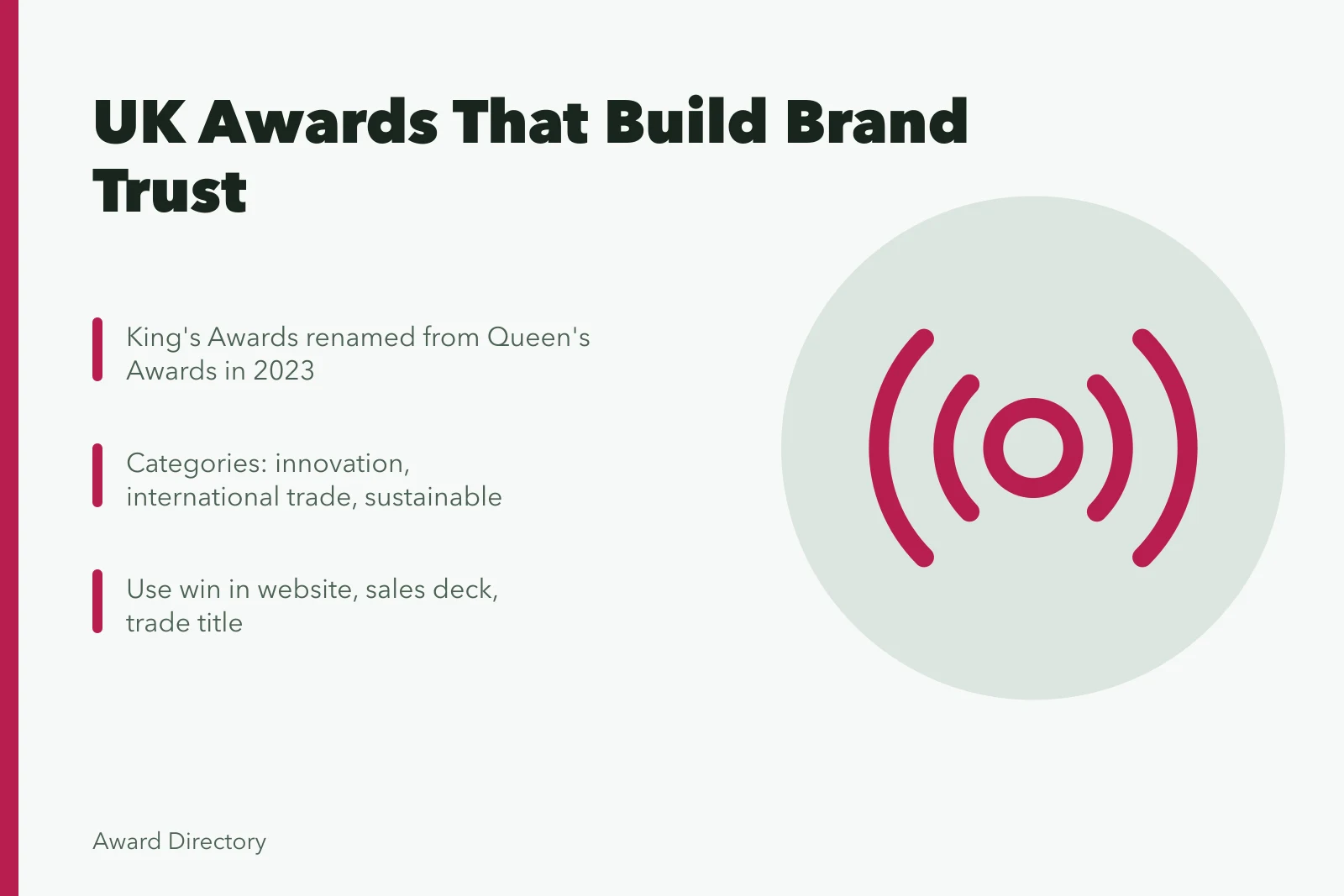
The Queen's Awards for Enterprise were renamed the King's Awards for Enterprise in 2023, following the change of monarch. The categories cover innovation, international trade, sustainable development and promoting opportunity.
The reputation value lies in the process. Applications are assessed against evidence you supply, and the award follows a panel's advice. A UK buyer is likely to have heard of the scheme even when your sector means nothing to them.
Eligibility rests on size and trading history rather than on marketing budget. The application is written, not bought, which is why smaller firms do win.
Which route suits which brand
Match the scheme to the buyer you want to reach.
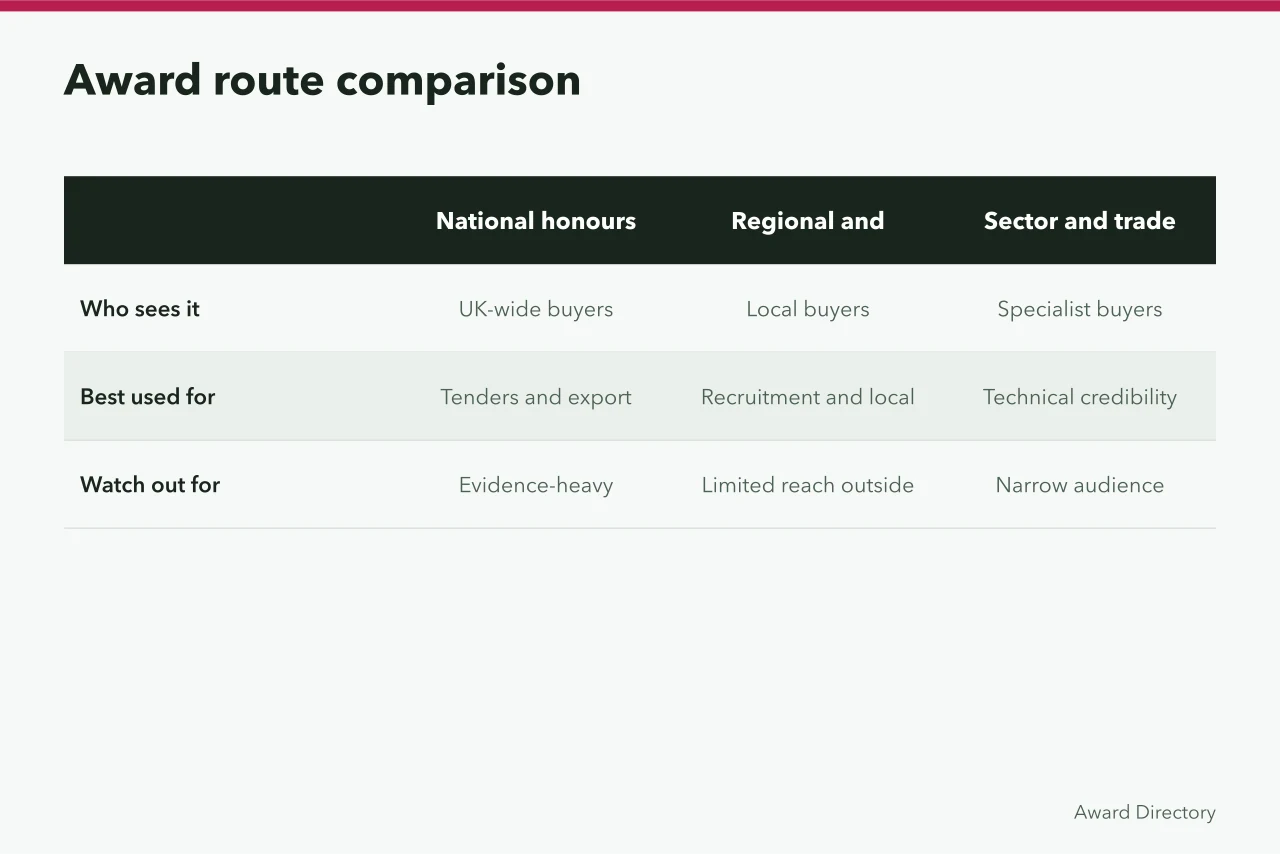
| Route | Who sees it | Best used for | Watch out for |
|---|---|---|---|
| National honours such as the King's Awards | UK-wide buyers and the public sector | Tenders and export marketing | Evidence-heavy written application |
| Regional and chamber awards | Local buyers and local press | Recruitment and local PR | Limited reach outside the area |
| Sector and trade body prizes | Specialist buyers and peers | Technical credibility | Narrow audience |
| Customer-voted awards | Consumers | Consumer brands | Result depends on campaigning effort |
Turning a win into reputation: five steps
- Check what the panel scores before writing anything. The UK business awards judging criteria differ on how much weight they give to evidence and financial data.
- Gather proof as you enter: customer numbers, growth figures and named case studies where clients have agreed to be quoted.
- Choose three places the win will appear, such as your website, your sales deck and a trade title, and set a date for each.
- Brief the people who speak to buyers. Recognition converts when the person in the room can say who judged the entry and against what.
- Keep a rolling record of entries, shortlists and wins, and re-check closing dates each year so the story stays current.
Keeping award claims inside the advertising rules
Award marketing is still marketing. The CAP Code requires advertisers to hold evidence for their claims, and the advertising codes are published by the Advertising Standards Authority.
Two mistakes recur. Describing a shortlisting as a win is a breach, and using a scheme's emblem without permission is a trademark problem as well as a code one.
If an award comes from outside the UK, name the country. A UK reader may otherwise assume a crest or a royal-sounding title is domestic.
Awards rarely bring cash with them. Firms that need capital should look at the public support routes listed on GOV.UK instead.
Common questions
Do UK company recognition awards increase sales?
Not on their own. An award shortens the gap between your claim and a buyer's belief, but any sales effect is hard to separate from the rest of your marketing.
How much does it cost to enter a recognition award?
Entry fees vary by scheme and category, and some trade body prizes are free to members. Add ceremony tickets and staff time to the total, because the fee is rarely the largest cost.
Which UK awards suit a small company?
Regional and sector schemes are usually the better first step, because judges know the market and fees are lower. A track record there strengthens later applications for national honours.
Can I use an award logo on my website?
Only within the organiser's terms, and only for the period the scheme allows. If the claim needs a footnote to be accurate, describe the award in words instead.