Strategy
Part of What are the UK business awards judging criteria?
What are the UK business awards judging criteria?
UK business awards judges rank measurable outcomes above polished prose. Here is how scorecards are weighted, what evidence counts and how to prepare an entry.
What to take away
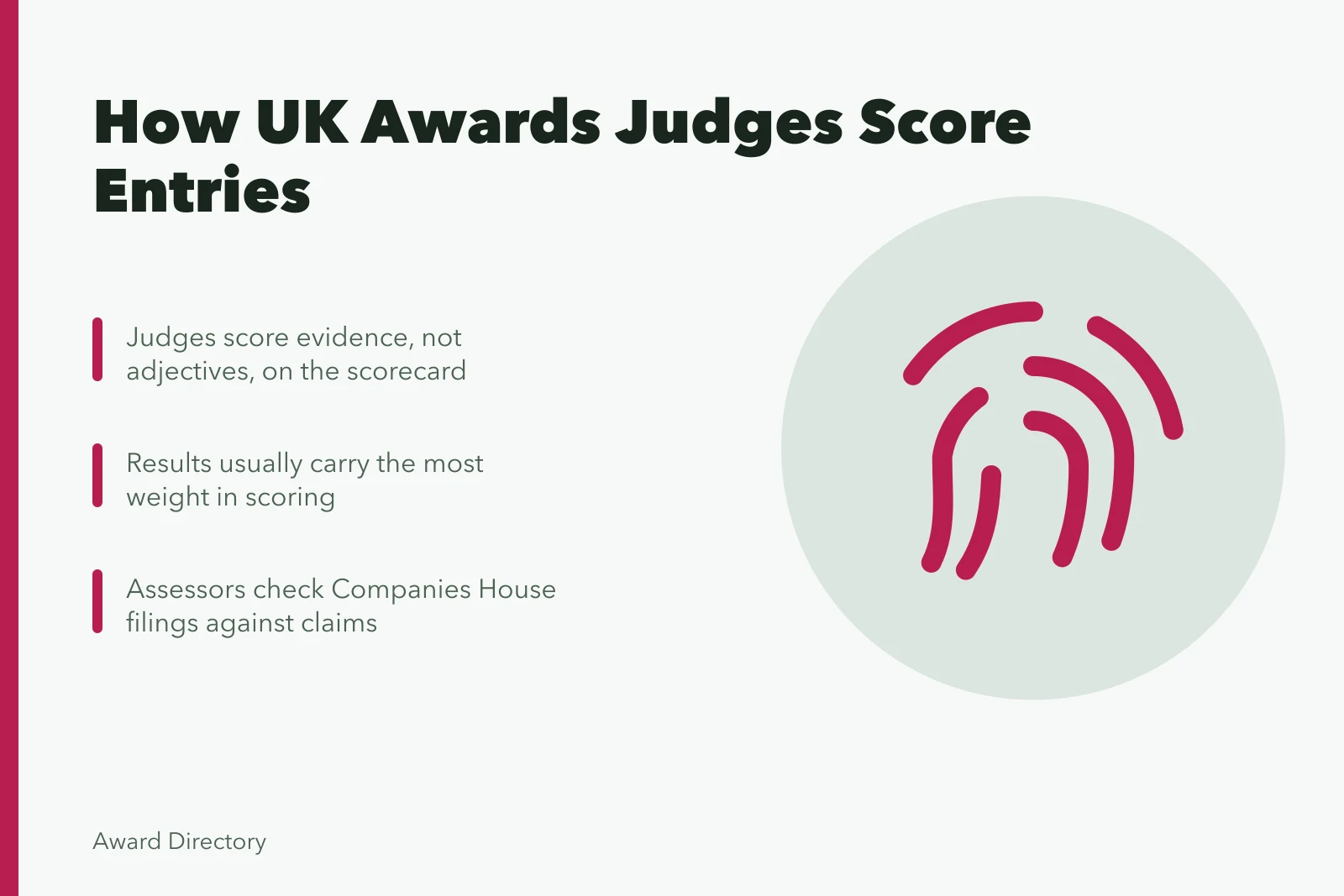
- Judges score evidence rather than adjectives. An entry that names an outcome and its source beats one that describes ambition.
- Every scheme sets its own scorecard, so read the criteria and the weighting before you draft a word.
- Results normally carry the most weight, with strategy and delivery behind them.
- Assessors can check public records and advertising claims, so keep both accurate.
- Smaller firms compete best by narrowing an entry to one campaign, one region or one client segment.
Who sets the judging criteria
UK award programmes are run by trade associations, professional institutes, publishers, chambers of commerce and event companies. No single regulator oversees business awards, so the scorecard published by the organiser is the only rulebook that counts.
Some organisers adapt frameworks from management bodies or quality standards. Others write their own. If the scorecard is not on the website, email the organiser and ask for it, because judges mark against that document rather than your press release.
What judges look for, criterion by criterion
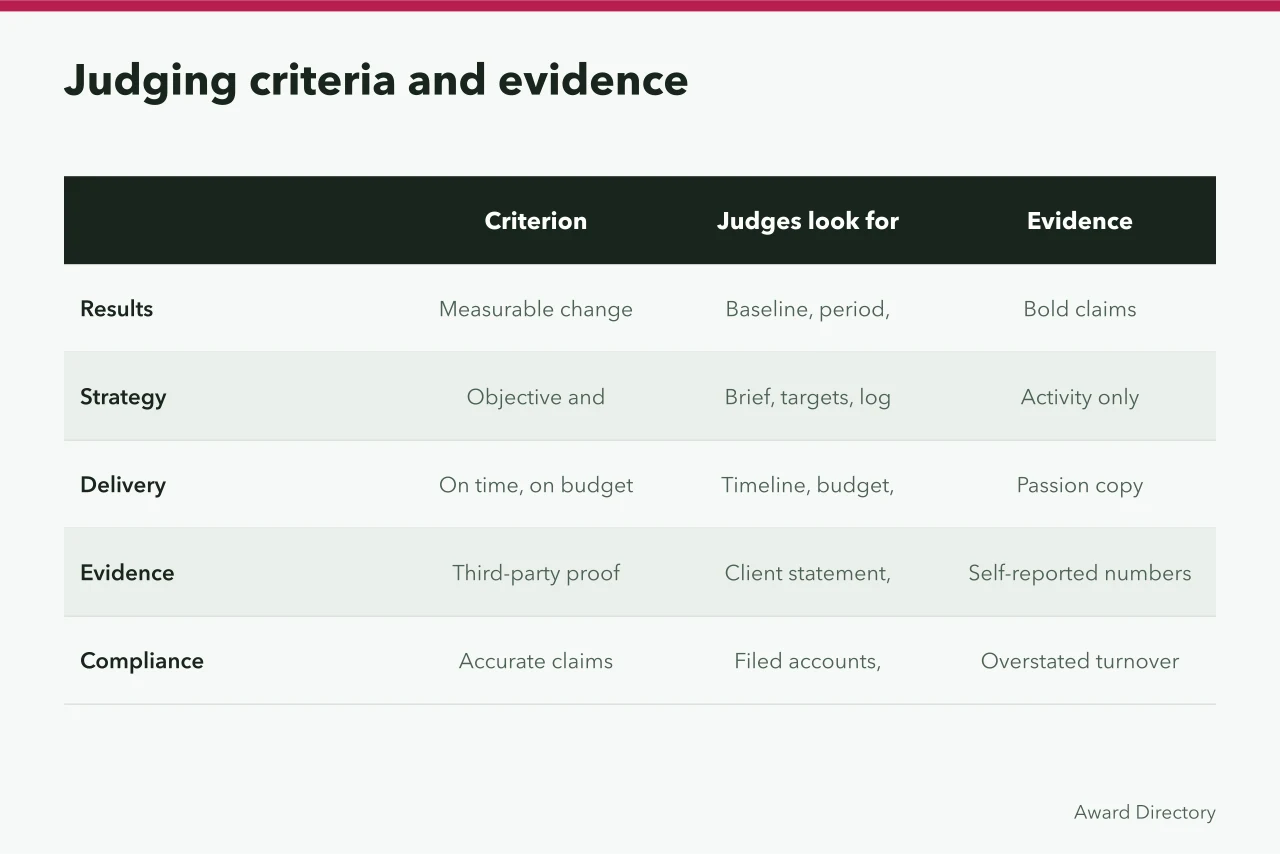
Most scorecards come down to the same questions: what changed, how do you know, and can you prove it. The table below shows how those questions usually appear.
| Criterion | What judges look for | Evidence that satisfies it | Where entries fail |
|---|---|---|---|
| Results | A measurable change in revenue, margin, retention or reach | Baseline, period measured, named source | Bold claims with no starting point |
| Strategy | A clear objective and a reason for the choices made | Brief, targets, decision log | Activity described instead of reasoning |
| Delivery | Work completed on time and within budget | Timeline, budget, named team roles | Copy about passion and innovation |
| Evidence | Third-party proof of the outcome | Client statement, management accounts, published data | Self-reported numbers nobody can check |
| Compliance | Accurate company and marketing claims | Filed accounts, substantiation held on file | Overstated turnover or unproven awards |
A short worked example makes this concrete. Suppose an agency claims a campaign added £180,000 of annual client revenue, a figure used here only for illustration. A judge can accept it only if the entry shows the baseline, the measurement period and who calculated the number. Illustrative figures are fine in early drafts, but the final entry needs client-approved numbers with a named source.
Building an evidence file that survives scrutiny
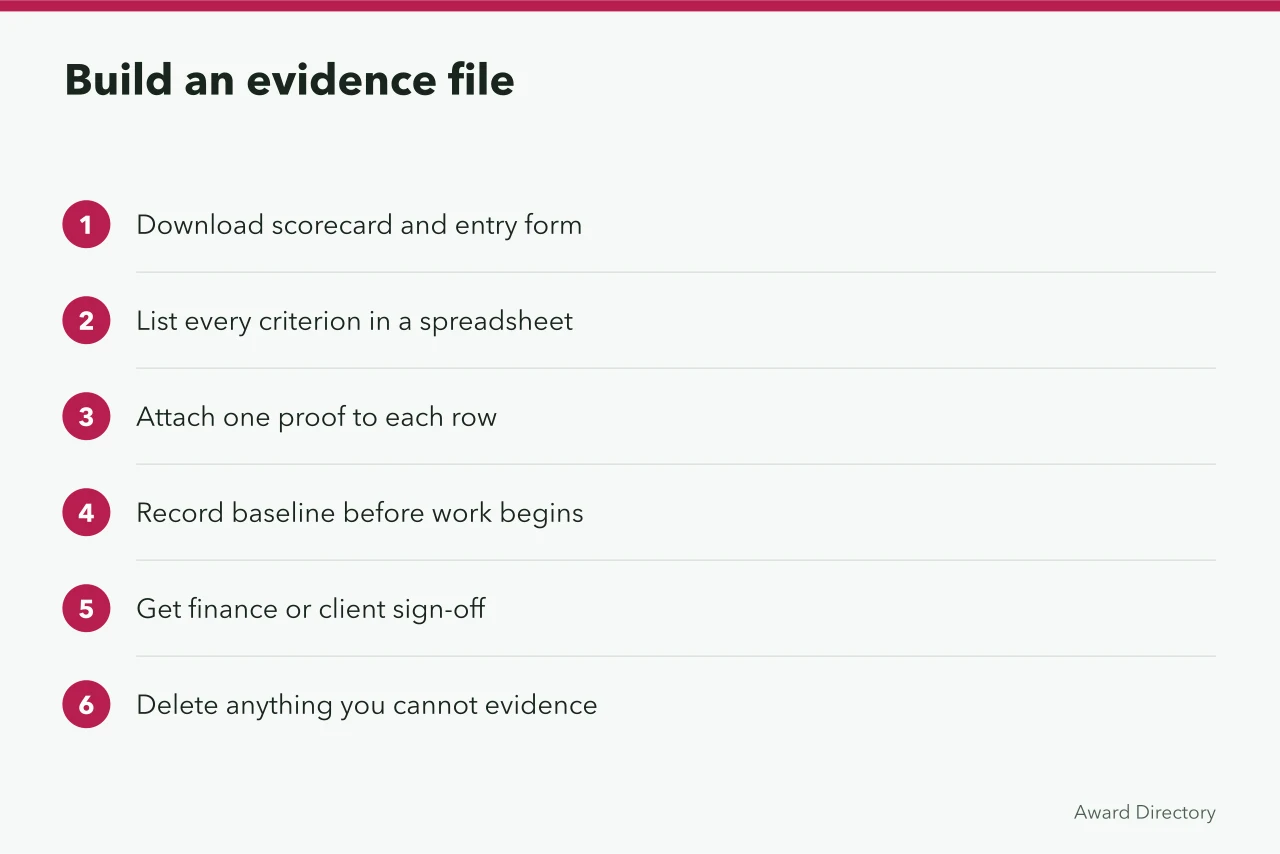
- Download the scorecard and the entry form, then list every criterion as its own row in a spreadsheet.
- Attach one piece of proof to each row: a client statement, an invoice, a management account or a published dataset.
- Record the baseline before the work begins, because a result without a starting point reads as a guess.
- Ask a finance or client contact to sign off the figures, and note their name and role.
- Delete anything you cannot evidence, however persuasive it sounds.
First-time entrants often lose marks on structure rather than substance. Pair the evidence file with a plain narrative, and follow the drafting sequence in our guide to how to enter UK branding awards so the entry stays inside the word limit.
Where entries lose marks
Overstated turnover is the most common own goal. Assessors and researchers can check filed accounts through the Companies House register, and a gap between the entry and the filing undermines every other claim.
Claims made inside an entry count as advertising. The CAP advertising codes require evidence to be held before a claim goes out, so keep substantiation for any comparative or performance statement.
Market context also matters. If you claim growth above the sector norm, compare it with published data from the ONS business and industry releases instead of asserting it.
Regional schemes and category choice
National awards draw the largest entry pools. Regional programmes usually field fewer entrants per category and judges who know the local market, which can work in a smaller firm's favour.
If you are weighing up where to spend the entry fee, regional business awards for SMEs often accept the same evidence under a different category name. Check each scheme's criteria before recycling anything.
Common questions
Do judges check the numbers in an entry?
Not always line by line, but organisers can request proof at any stage and public filings are simple to check. Treat every figure as though it will be reviewed.
How many criteria do most UK schemes use?
Typically four to seven, covering results, strategy, delivery and evidence. The weighting of each criterion matters more than the total number.
Can a small company beat larger entrants?
Yes, if the entry is scoped tightly. Judges score the campaign or the trading year described, not the headcount of the business.
Should we reuse the same evidence across awards?
Often yes, provided each version is rewritten to match that scheme's criteria and word limit. A submission copied without edits is easy to spot.