Tools and providers
Part of Which are the best PR awards for small UK agencies?
Which are the best PR awards for small UK agencies?
A named comparison of PR award schemes for small UK agencies, from CIPR PRide and PRCA Dare to Prolific North, The Drum and specialist options.
What to take away
- Regional and specialist PR awards are the realistic targets for small UK agencies. The entry pool is smaller and judges are closer to the work.
- Named schemes to compare include CIPR PRide Awards, PRCA Dare Awards, Prolific North Awards, The Drum PR Awards, and PRCA Awards.
- The entry fee is rarely the biggest cost. Writing time, photography, and ceremony tickets usually add up to more.
- Check the shortlist ratio, the judging panel, and how winners are published before you pay.
- Enter only if you have a plan for using the win commercially.
Why the big national schemes are a hard sell
National PR awards draw entries from every network agency and large independent in the country. A five-person agency can win, but the odds are long. Judges expect national coverage alongside hard numbers.
Public relations rests on reputation and relationships. Those are harder to prove in 500 words than a media spend or a rebrand. Most independent PR agencies sit inside the SME definition of fewer than 250 staff. They enter the same categories as businesses with award-writing teams and marketing budgets to match.
Named schemes worth targeting
These schemes are real and open to UK agencies. Check current entry packs for dates, fees, and regional rules.
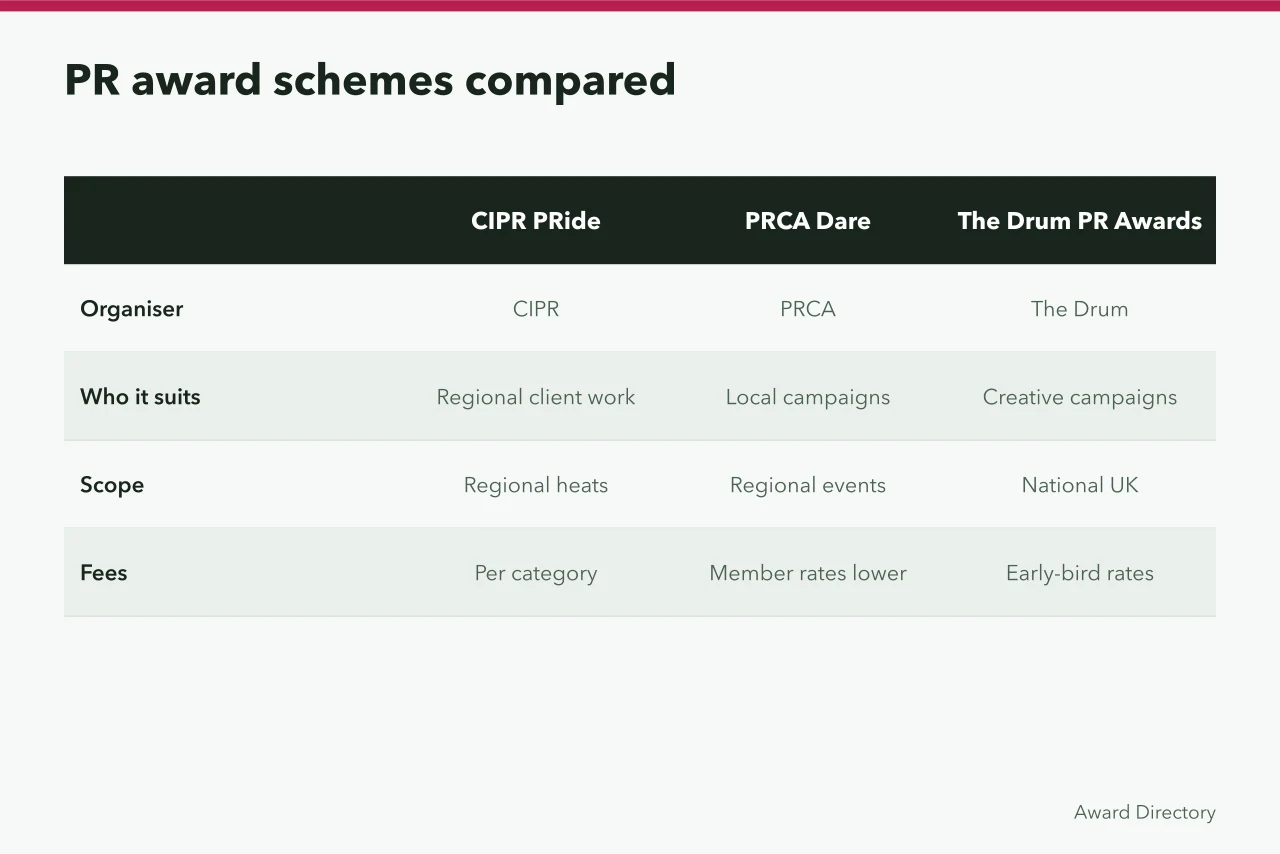
| Scheme | Organiser | Who it suits | Pricing or limit |
|---|---|---|---|
| CIPR PRide Awards | Chartered Institute of Public Relations | Agencies with regional client work | Regional heats across the UK. Entry fees are per category and vary by region. |
| PRCA Dare Awards | Public Relations and Communications Association | Small agencies with local campaigns | Regional events in Scotland, Wales, the North, Midlands and South. Member rates are lower. |
| Prolific North Awards | Prolific North | Agencies based in the North of England | Categories cover PR, marketing and media. Early-bird entry rates usually apply. |
| The Drum PR Awards | The Drum | Agencies with creative, results-led campaigns | National UK scheme. Entry fees are per category and early-bird rates apply. |
| PRCA Awards | Public Relations and Communications Association | Agencies with national client work | National UK scheme. Entry fees are tiered by member status. |
| CIPR Excellence Awards | Chartered Institute of Public Relations | Agencies with national campaigns | National UK scheme. Entry fees are higher than the PRide Awards. |
| Corporate Content Awards | Communicate magazine | Content, PR and brand agencies | UK-focused. Entry fees are per category. |
Category choice matters as much as the scheme. This guide to PR awards categories explains how the splits usually fall. A campaign that won local press coverage often looks stronger in a regional scheme than a London campaign that did not. Small agencies should pick the scheme that matches their client base, not the one with the biggest name.
A worked example: one regional entry
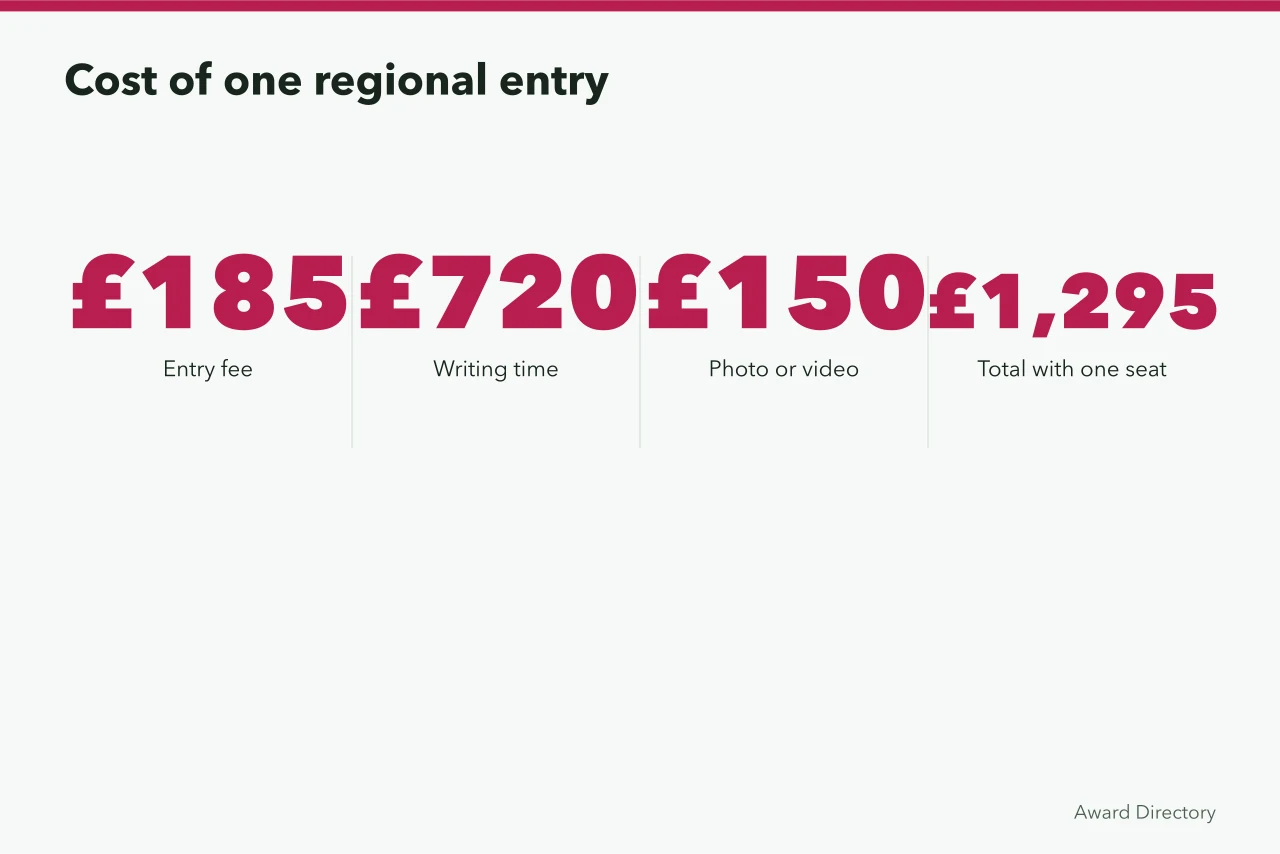
- Entry fee for a single CIPR PRide category: £185 illustrative.
- Writing time: 12 hours of a senior consultant at £60 an hour, so £720.
- Photography or a short video edit: £150.
- One seat at the ceremony: £120, or £950 for a table of eight.
- Repurposing the shortlist announcement across your site and social channels: two hours, about £120.
- Total for one entry with a single seat: about £1,295, or about £2,125 with a table.
Every figure here is illustrative and excludes VAT. Set the result against a typical retainer and judge it as marketing spend, not as a cost of doing business.
How to check a scheme is worth the money
Work through these questions before you pay an entry fee:
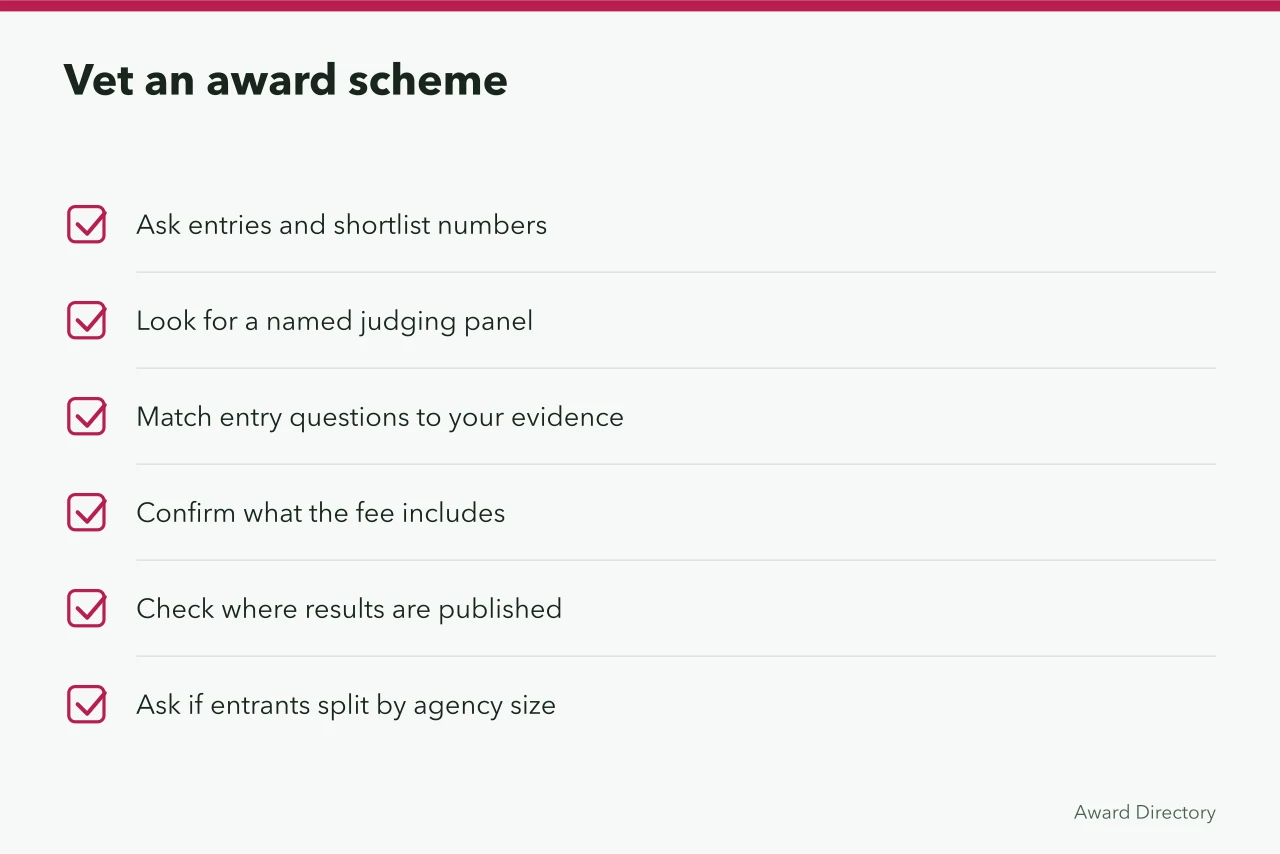
- Ask how many entries the category received last year and how many were shortlisted. A scheme that publishes those numbers usually has nothing to hide.
- Look for a named judging panel, ideally including client-side marketers and journalists you recognise.
- Check that the entry questions match evidence you already hold, such as coverage or share of voice.
- Confirm what the fee includes: feedback, a judges' citation, a trophy, or nothing beyond a place on the shortlist.
- Read where the results are published. A win nobody reports is a line on your website and little else.
- Ask whether the scheme separates entrants by agency size. Smaller agencies do better when they are not measured against national campaigns. This list of regional business awards for SMEs covers schemes that split by turnover.
Common questions
Which PR awards are easiest for a small agency to win?
CIPR PRide Awards and PRCA Dare Awards are strong starting points. Their regional heats have smaller entry pools. Prolific North Awards also suit agencies in the North of England. Low entry numbers do not automatically mean low prestige, so check who else enters.
How much should a small agency budget for award entries?
Treat entries as marketing spend. One regional entry with a ceremony seat can come to around £1,295 in illustrative costs. Most of that is staff time rather than fees. Two or three well-chosen entries a year is enough for a team of five to ten people.
Do regional awards carry the same weight as national ones?
They carry different weight. National wins travel further with large prospects. Regional wins help with local clients and recruitment. Choose according to where your next ten clients are likely to come from.
Can we describe ourselves as award-winning?
Only when the claim is accurate and you can show the evidence. The CAP Code applies to your own marketing. Name the award and the year rather than making a vague claim.