
Reviews
Part of In-house communications awards UK: which are worth entering?
In-house communications awards UK: which are worth entering?
In-house communications awards in the UK, from IoIC to CIPR Inside: how to judge which schemes suit internal comms teams and what a strong entry costs.
What to take away
- The awards most often recommended for in-house practitioners are the IoIC Awards and CIPR Inside, both built around internal campaigns rather than client work.
- General business award schemes are worth considering when your internal comms project produced a clear commercial or cultural result.
- Judges look for measured outcomes and evidence, not a description of the channels you used.
- Budget staff time, sign-off and evidence gathering, not just the entry fee.
Why in-house teams are a different entry
Internal communication covers leadership messaging, intranet content, employee engagement and change programmes. Wikipedia's overview of corporate communication explains how that work sits alongside external PR and reputation management. In-house teams own the channel, the audience and the result.
Many awards, though, are designed around agency case studies. The entrant is a consultancy and the story belongs to a client. In-house entrants often have no client to name and no campaign budget to point to. That is why the dedicated internal comms schemes matter.
The UK schemes built for in-house teams
The Institute of Internal Communication runs an annual awards programme for practitioners employed inside organisations. CIPR Inside, the internal communications group within the Chartered Institute of Public Relations, aims its awards at the same in-house audience. Check the current cycle on each organiser's site, because categories and deadlines change. Most schemes also publish category guidance and lists of past winners.
Larger business award programmes also carry categories for employee engagement, change communication and employer brand. Those suit projects with a hard result attached, such as a fall in leaver rates or a smoother merger. A list of business and industry awards gives a sense of how crowded the field has become.
What a strong entry contains
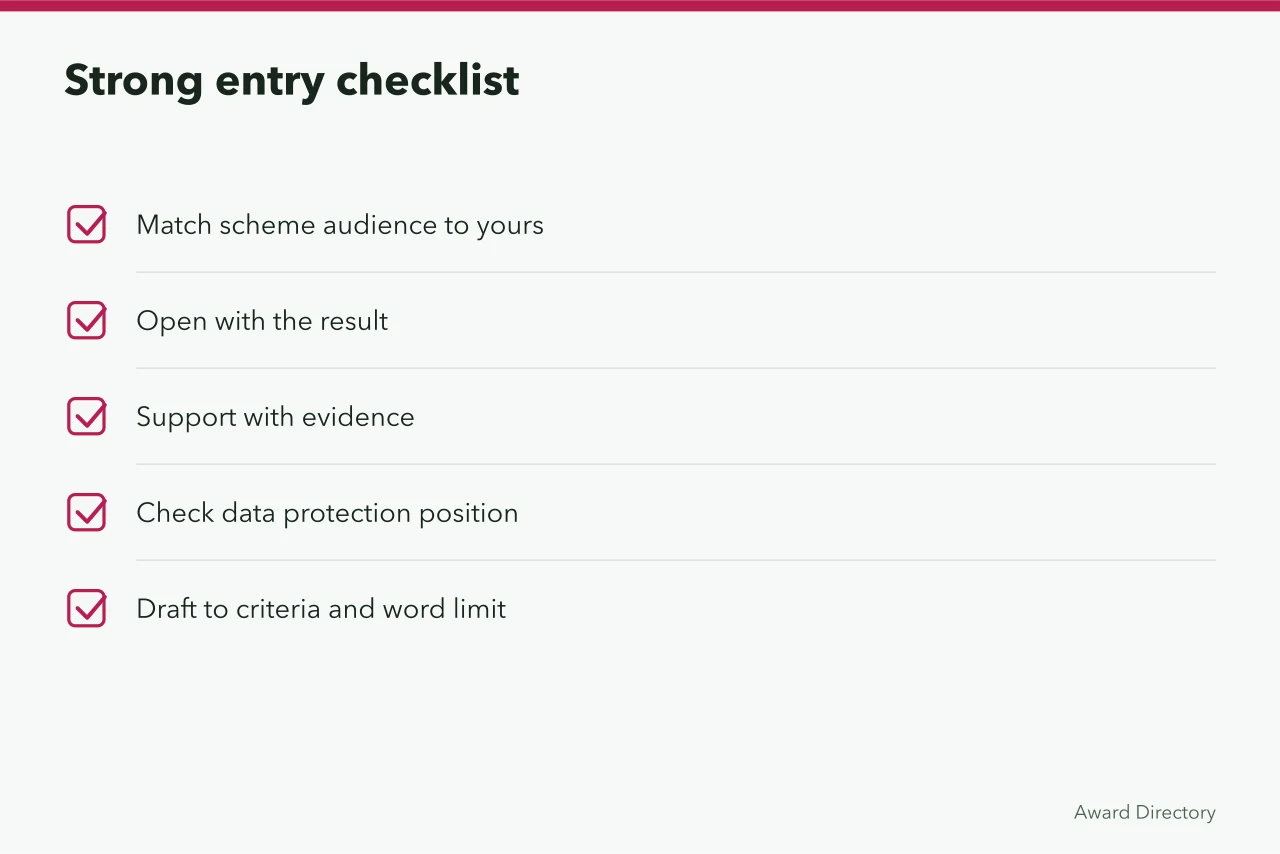
- Choose the scheme whose audience matches yours, not simply the best-known name.
- Open with the result: what changed, by how much and over what period.
- Support it with evidence, such as pulse survey scores, intranet analytics or manager feedback.
- Check your data protection position before quoting employees or reusing survey results.
- Draft to the category criteria and word limit, then ask someone outside the team to read it.
Most schemes publish weightings for results, strategy and execution. Read the UK business awards judging criteria before you write, because they show how much space each section deserves.
If you quote employees or reuse survey data, the guide for organisations from the ICO explains what data protection law expects. That includes telling people how their words will be used.
What an entry costs in time and money
Most schemes charge a fee per entry and publish the rate next to each category. Some offer early-bird pricing. Check whether the fee covers ceremony tickets, since table costs are often separate. The larger cost is usually internal: writing time, design, video and the review hours of the senior leaders whose sign-off you need.
Get finance and legal sign-off early if the entry cites figures that are not yet public.
Work backwards from the deadline. A maintained awards deadlines calendar shows when the main UK communications cycles open and close, so two entries do not land in the same fortnight.
Is it worth entering?
An in-house comms award is worth the effort when the work is finished and measured. A win gives the team external proof that internal communication changed something, which is harder to demonstrate than a sales figure. Entering also forces you to document what you did, which is useful evidence at budget time.
If the project is still running, note the baseline now. You will need it whether you enter next year or simply report to your board.
Common questions
Are in-house communications awards only for large teams?
No. Solo practitioners and small teams enter these categories, and judges tend to score the quality of the thinking rather than the size of the budget.
Do we need an agency to write the entry?
No, but a second reader helps. Some teams hire a designer or videographer to polish the submission, while the argument comes from the people who did the work.
Can we reuse an entry from a different award?
Sometimes, but check the rules first. Word limits, category criteria and eligibility windows differ, and a recycled entry that ignores the brief scores poorly.
How much does it cost to enter?
Fees vary by scheme and category, and organisers publish them alongside the category list. The heavier cost is usually the staff time spent writing and gathering evidence.