Operations
Part of UK communications awards deadlines: a calendar for entrants
UK communications awards deadlines: a calendar for entrants
A practical UK communications awards deadlines calendar, covering PR, branding and in-house recognition cycles, with prep steps and budget notes for entrants.
What to take away
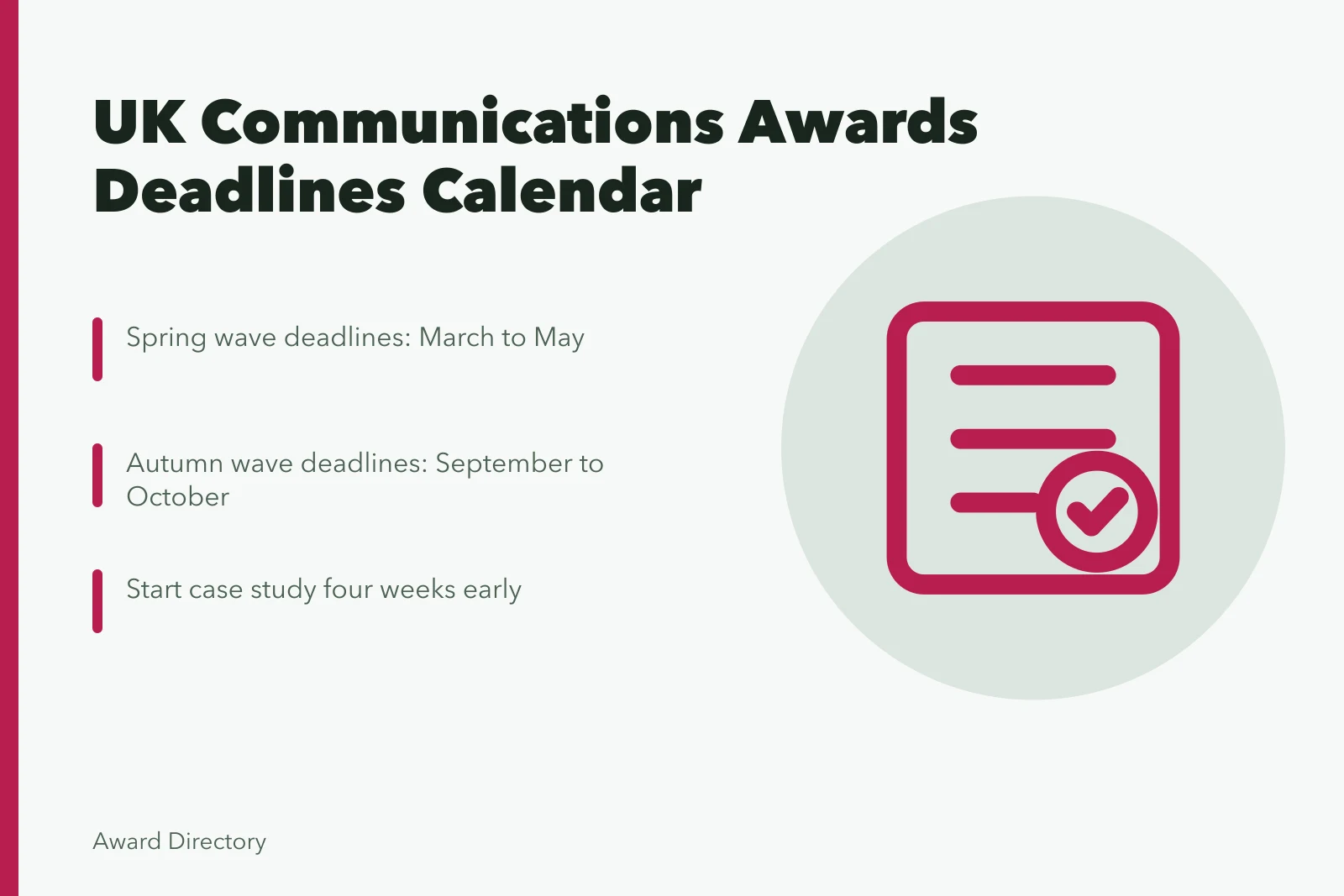
- UK communications awards run in two entry waves, spring and autumn.
- Budget approval follows the financial year, not the awards calendar.
- Deadlines move by weeks between cycles, so confirm dates with each organiser.
- Writing the case study takes longer than the entry form. Start four weeks early.
- Clash-check your shortlist so two strong entries never share a week.
Where the UK awards year gets its shape
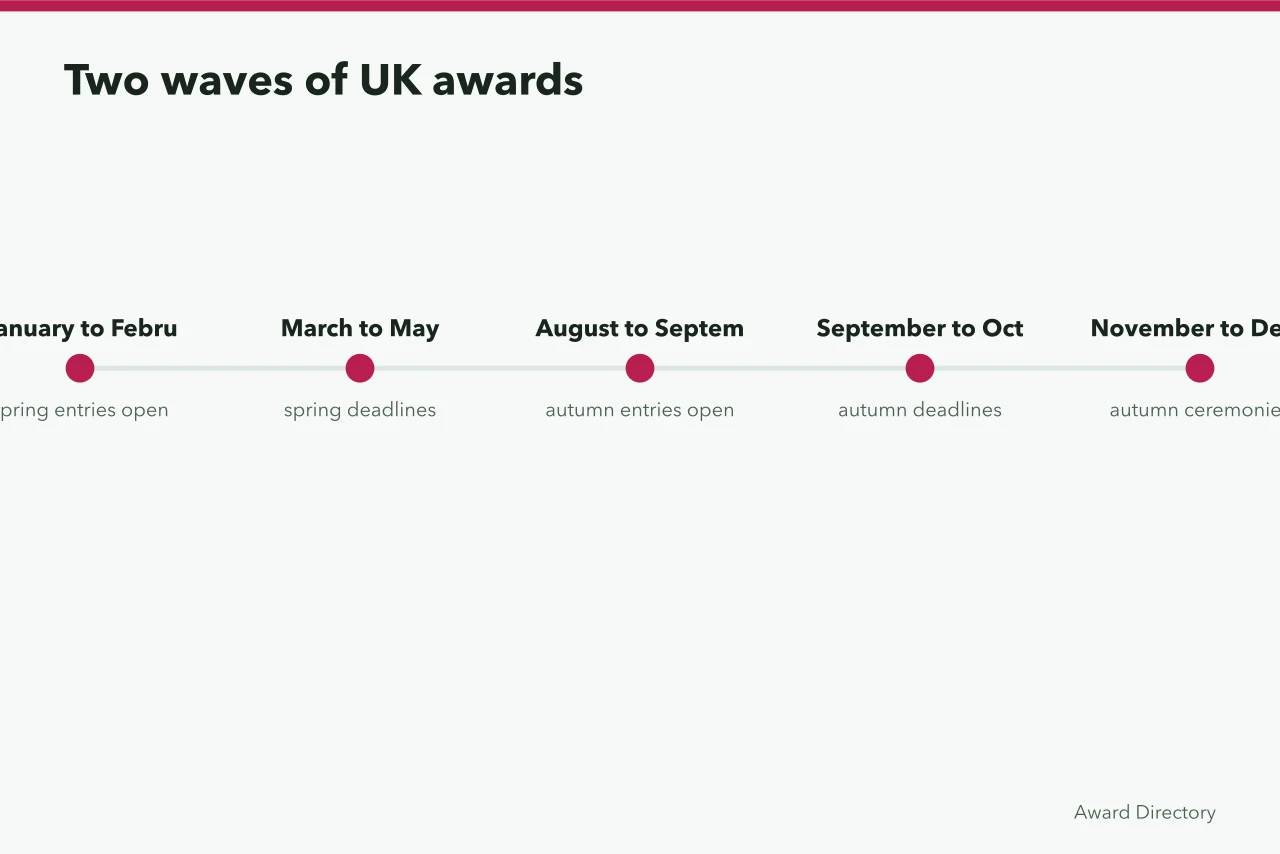
UK communications awards run on two waves. A spring wave opens entries in January and February, with deadlines falling between March and May. A second wave opens in late summer, taking deadlines into September and October. Ceremonies for that wave usually land before Christmas.
Money shapes the pattern. Marketing budgets are set annually, and many UK finance teams plan to an April start, close to the tax year that begins on 6 April. A fee of a few hundred pounds sterling is far easier to approve once the year's plan is signed off.
Deadline changes are normal. A scheme that closed in April one year may move to May the next, and extensions appear when entries run thin. Re-check every date at the start of the cycle rather than trusting last year's diary.
A calendar by season
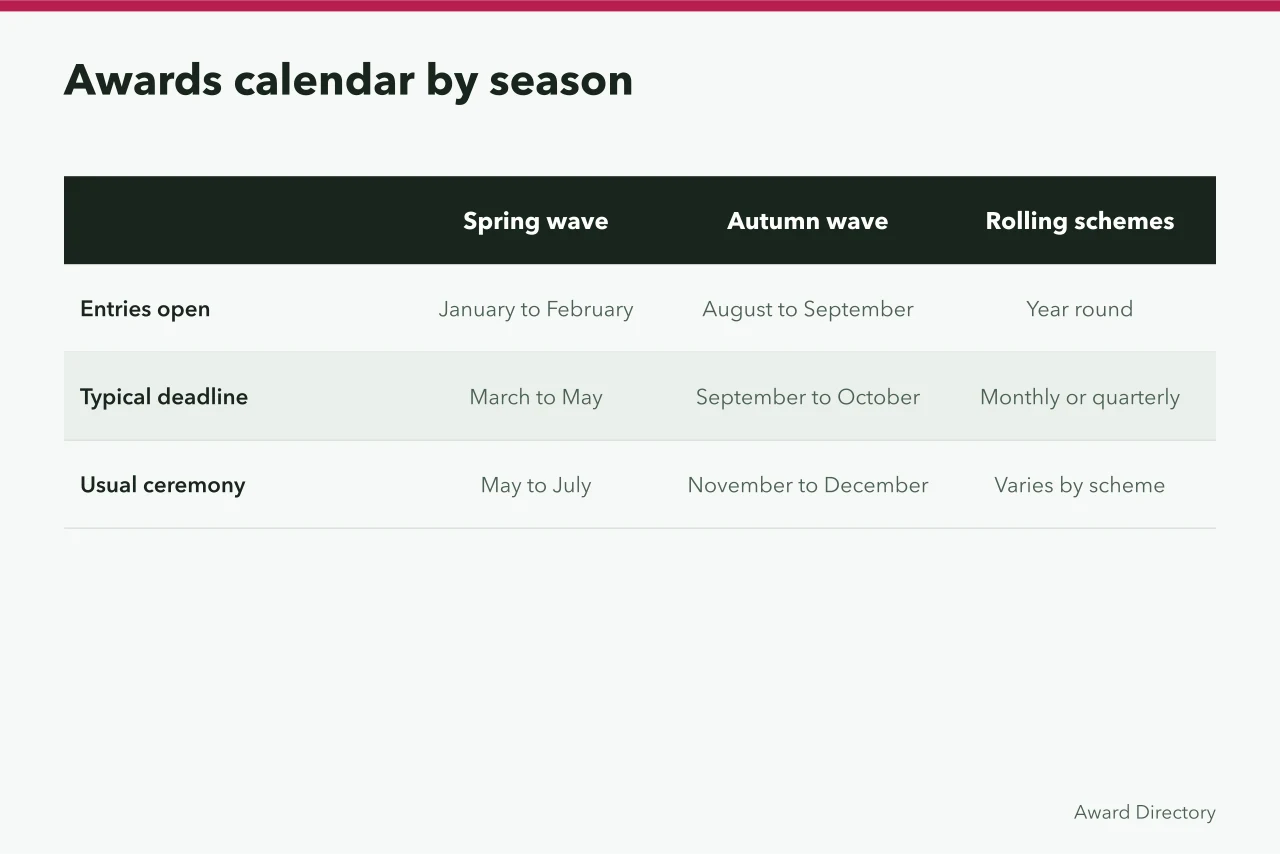
Treat the table as a shape, not a schedule. Organisers shift dates by a few weeks between cycles, so check the current entry page before you commit a budget.
| Season | Entries usually open | Typical deadline | Usual ceremony |
|---|---|---|---|
| Spring wave | January to February | March to May | May to July |
| Autumn wave | August to September | September to October | November to December |
| Rolling schemes | Year round | Monthly or quarterly | Varies by scheme |
Sector awards such as the PRWeek UK Awards and the CIPR Excellence Awards each follow their own annual cycle, and they do not always sit in the same wave. The field is broad, and Wikipedia's list of business and industry awards shows how many schemes now run across the UK.
Build a deadline calendar you will actually use
A directory tells you what exists. Your own calendar tells you what to do this month. Category choice decides whether a strong campaign scores, and our guide to PR awards categories in the UK explains how entries are grouped. Work through these steps once, then repeat them each year.
- Shortlist eight to ten awards that match your sector, size and region.
- Record the opening date, deadline and ceremony date for each, plus the page you checked.
- Work back four weeks from every deadline to set a first-draft date.
- Group entries that share the same evidence, so one campaign serves two or three of them.
- Book director sign-off two weeks before submission, not two days.
- Review last year's feedback in the quiet months and rewrite the weakest section.
What to prepare before entries open
Judges score the case study, not the marketing copy around it. Write the results first, then the narrative that explains them.
Category choice matters as much as the writing. A campaign can fit several categories, and the strongest evidence should decide which one you enter.
Evidence is the usual gap. Collect results as they happen, because six months later nobody remembers the exact figures. The ONS publishes business and industry data that can support market-size claims in a case study, which gives judges a figure they can check.
Budgeting fees, time and approvals
Entry fees vary. Some schemes are free to enter, others charge per submission, and many add a smaller fee for each extra category. Our breakdown of UK branding awards entry fees explains what drives those differences.
Time is the bigger cost. A serious entry takes a day to draft and half a day to approve. GOV.UK's finance and support pages are worth checking if entry costs compete with other growth spending.
Common questions
When are UK communications awards deadlines?
Most deadlines fall between March and May, or between September and October, and a few schemes run monthly rounds. Treat those windows as a starting point and confirm the dates on the organiser's entry page.
Do communications awards charge entry fees?
Most charge per category, though some professional bodies offer member rates and a few small schemes are free. Check the fee schedule before you decide how many categories to enter.
Can one campaign be entered for several awards?
Often yes, provided the campaign ran in the qualifying period and you hold the rights to the material. Some organisers bar entries that have already won elsewhere, so read the terms.
How early should I start a case study?
Four weeks before the deadline is the practical minimum. If the results are still coming in, build the structure early and add the figures as they are signed off.