Costs and pricing
Part of UK branding awards entry fees: what to expect
UK branding awards entry fees: what to expect
UK branding awards entry fees vary by category, scheme and company size, with some free categories. Here is what budgeting entrants should expect to pay.
What to take away
- Branding award schemes usually charge per category entered, not per company, so costs rise quickly.
- Fees tend to scale with category prestige, organisation size and whether the organiser is a trade body or a commercial event.
- Free categories exist, but they are usually aimed at in-house teams, micro businesses or first-time entrants.
- The entry fee is rarely the whole cost: ceremony places, trophy duplicates and late surcharges add up.
- Transparent pricing is now a deciding factor for marketing teams comparing two or three schemes.
Why branding award fees vary
Branding sits inside a wide awards market. Some schemes are run by trade bodies to promote the sector; others are commercial ventures where entry income funds the ceremony. A scan of the list of business and industry awards shows the range, from single-category prizes to programmes with dozens of classes.
Pricing is rarely a single number. Fees can differ by category, by the number of entries filed, by organisation size and by submission date. If you are weighing a branding-focused scheme against a broader design prize, our comparison of branding awards and design awards explains which suits identity-led work.
Repeat entrants feel the scaling effect. One identity project filed under three categories costs three entry fees, before any ceremony tickets or trophy orders.
The main fee structures compared
Most UK schemes, including branding-led programmes such as the Transform Awards, publish a rate card rather than a single price.
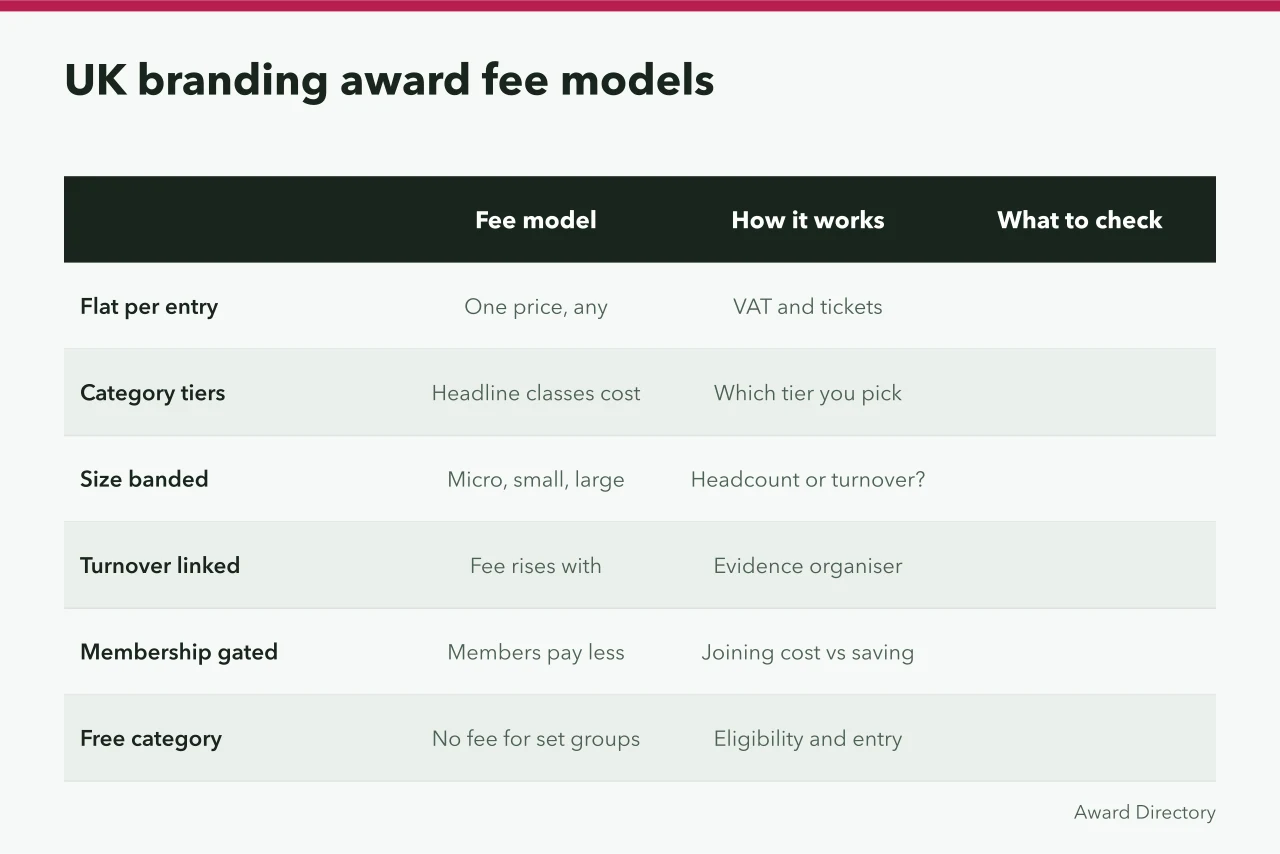
| Fee model | How it works | What to check |
|---|---|---|
| Flat per entry | One price covers any category | Whether VAT and ceremony tickets are included |
| Category tiers | Headline classes cost more than core classes | Which tier the entrant picks |
| Size banded | Micro, small and large firms pay different rates | Headcount or turnover as the measure |
| Turnover linked | Fee rises with declared annual turnover | Evidence the organiser accepts |
| Membership gated | Members pay less than non-members | Joining cost against the saving |
| Free category | No fee for a defined group of entrants | Eligibility wording and entry limits |
How organisation size changes the bill
Size bands are not an award invention. Company law sets thresholds that separate micro, small and medium companies by turnover and balance sheet totals, and many organisers borrow those figures because entrants recognise them.
Banding makes commercial sense. A 12-person studio and a 400-person network rarely carry the same marketing budget. The Office for National Statistics publishes UK business population data broken down by firm size, a useful cross-check when an organiser asks you to declare a band.
Check which measure the organiser wants. Some use headcount, some use turnover, and a few ask for both with supporting accounts. Declaring the wrong band can mean a reclassification, or a top-up invoice after shortlisting.
A worked example for a small agency
The figures below are illustrative, not a quotation from any named scheme, and they show how a modest entry grows.
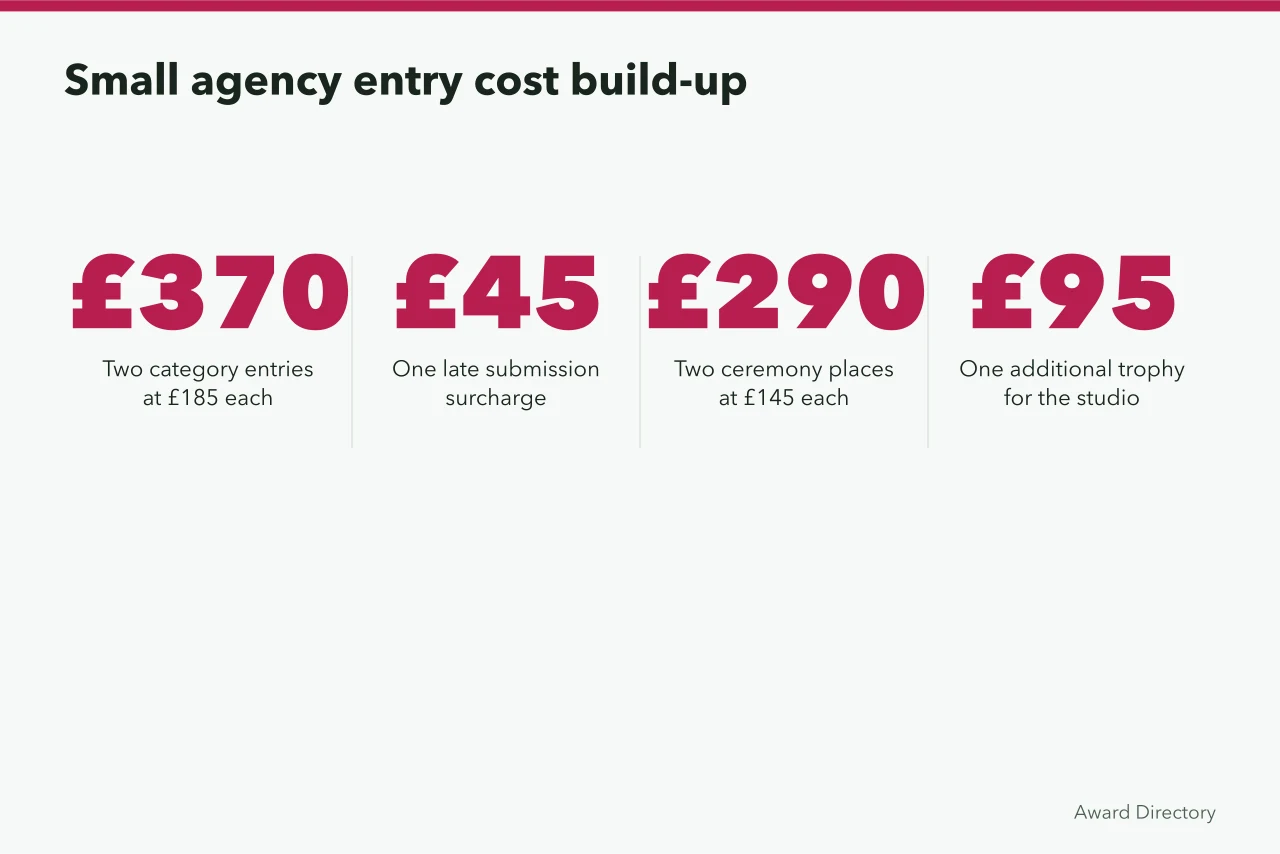
- Two category entries at £185 each: £370
- One late submission surcharge: £45
- Two ceremony places at £145 each: £290
- One additional trophy for the studio: £95
- Total payable before VAT at 20%: £800, plus £160 VAT
VAT matters here, because quoted fees are often exclusive. If your agency is not VAT registered, that 20% is not recoverable, so a £185 entry is really £222.
Free categories and the extras that add up
Free categories usually reward a type of entrant rather than a type of work: in-house teams, charities, students or first-time entrants. They are genuine, but they often carry a condition such as membership of the organising body, or a limit of one free entry per organisation.
Extras are where budgets break. Ceremony places, printed certificates, trophy duplicates and courier costs are rarely included in the headline rate.
- Read the eligibility wording, including any membership condition.
- Confirm whether the quoted fee includes VAT.
- Note the standard deadline, not the extended one.
- Ask what a shortlisted entry includes and what costs extra.
- Compare the total against two other schemes before you pay.
Timing shapes the total as much as price does, because many schemes run an early-bird window that closes months before the ceremony. Our UK communications awards deadlines calendar maps those windows across the year, which makes annual budgeting easier.
Common questions
Do branding award schemes charge per entry or per company?
They charge per entry in nearly every case. Filing the same project in three categories means three fees, unless the organiser offers a multi-entry discount.
Are there free UK branding award categories?
Yes, but they are narrow. Free classes usually target in-house teams, charities or first-time entrants, and a paid entry elsewhere in the same scheme may be needed.
Does company size change the entry fee?
Often it does. Many schemes set lower rates for small firms, using bands similar to the company law thresholds, so check whether the organiser measures headcount or turnover.
What costs sit outside the entry fee?
Ceremony places, trophy duplicates, late surcharges and membership fees where a members' rate is offered. Ask for the full list before you commit.